Intersection of International Law and U.S. Foreign Policy
- What is your general view of the role of international law in U.S. foreign policy?
Since the founding of our nation, the United States has championed international law because we benefit from it. Promoting - and respecting - clear rules that are consistent with our values allows us to hold all nations to a high standard of behavior, and to mobilize friends and allies against those nations that break the rules. Promoting strong international norms helps us advance many interests, including non-proliferation, free and fair trade, a clean environment, and protecting our troops in wartime. Respect for international legal norms also plays a vital role in fighting terrorism. Because the Administration cast aside international norms that reflect American values, such as the Geneva Conventions, we are less able to promote those values abroad.
- Please provide an example of how this general view might play out in a specific policy context?
One specific example is the Geneva Conventions and whether that particular international legal framework should be applied to detainees. In my view, the Geneva Conventions should apply to those captured on the battlefield overseas by our armed forces. Some lawyers and legal scholars argue that alleged terrorists and terrorist organizations are not protected by the Geneva conventions because they do not wear uniforms and do not comply with the laws of war. But there have been many occasions since 1949 when it was less than clear if the Geneva framework applied fully to every person we detained in a conflict - during the Korean War, for example, which took place before we finished ratifying the Geneva Conventions, and during Vietnam, when our chief adversary was the Viet Cong. Yet in all these cases, we decided that it was in our interest to afford Geneva protections to all captives, so that we could hold our enemies to the same standard. In this conflict, too, we should apply the most basic protections of the Geneva Conventions, as the Supreme Court held last year, because as Americans we must set a high standard for ourselves and for the world. We are committed to the rule of law because that is who we are. By raising our standards for the world to see, we bring allies to our side and strengthen our standing and our moral authority in the world. In particular this will aid our cause in those parts of the world where we are engaged not only in a military conflict but also in a battle of philosophies, a struggle of competing ideologies. That is the American way. |
International Legal Regimes
- What priorities or goals would you establish for the development of existing or new international legal regimes?
The next president will have to prioritize restoring our traditions of adherence to international legal regimes and norms. When I am President, America will reject torture without exception. America is the country that stood against that kind of behavior, and we will do so again. I also will reject a legal framework that does not work. There has been only one conviction at Guantanamo. It was for a guilty plea on material support for terrorism. The sentence was 9 months. There has not been one conviction of a terrorist act. As president, I will close Guantanamo, reject the Military Commissions Act, and adhere to the Geneva Conventions. Our Constitution and laws such as our Uniform Code of Military Justice provide a framework for dealing with the terrorists.
The Administration has put forward a false choice between adhering to domestic and international law and providing security to the American people. These legal regimes exist precisely to keep us safe, and I will make clear that my Administration has faith in the rule of law.
- What priorities would you set for Senate advice and consent on treaties currently lacking U.S. ratification?
There are a number of meritorious treaties currently pending before the Senate. Some of these are clearly in the national interest, such as the UN Convention on the Law of the Sea, the Comprehensive Nuclear Test Ban Treaty, the International Convention for the Suppression of Acts of Nuclear Terrorism, and the Convention on the Elimination of All Forms of Discrimination Against Women. As president, I will make it my priority to build bipartisan consensus behind ratification of such treaties. |
International Trade Policy
- What would be your administration's international trade policy?
I would ensure that trade agreements include strong and enforceable labor and environmental standards. Companies operating overseas must not gain a competitive advantage by exploiting workers or the environment. But merely adding words to the core of our trade agreements is not enough. We must enforce our agreements through the World Trade Organization and other existing mechanisms and pressure our trading partners to end unfair government subsidies to foreign exporters, non-tariff barriers on U.S. exports, and artificially devalued currency, like China's, that puts U.S. companies at a perpetual disadvantage. As President, my trade policy will open foreign markets to create and support good American jobs.
- Would you seek any modification of existing trade agreements?
I believe the absence of labor and environmental standards in NAFTA was a mistake. We should build upon NAFTA to make it work better for workers.
- What would be your approach to the WTO and future global trade talks?
As president, my trade policy and practices will open foreign markets to create and support good American jobs. Negotiating trade agreements that open new markets can be helpful, but these agreements must contain appropriate labor and environmental standards. And they must be vigorously enforced.
We need a trade policy that makes the pie bigger - as big as possible - and we need to make sure Americans are positioned to win as large a share of that growing pie as they can. Looking forward, the keys to winning this competition are making long-term investments in areas like education and science and technology.
And we have a responsibility to help the American workers who are hurt by rapid advances in technology and by the dislocation that trade can bring. We need to get smarter and more serious about how we can use a range of policy tools that directly help the affected workers, like retraining, unemployment insurance and adjustment assistance. |
International Criminal Court
- What should be the U.S. policy toward the ICC?
Now that it is operational, we are learning more and more about how the ICC functions. The Court has pursued charges only in cases of the most serious and systemic crimes and it is in America's interests that these most heinous of criminals, like the perpetrators of the genocide in Darfur, are held accountable. These actions are a credit to the cause of justice and the rule of law; they deserve full American support and cooperation. Yet the Court is still young, many questions remain unanswered about the ultimate scope of its activities, and it is premature to commit the United States to any course of action at this time.
The United States has more troops deployed overseas than any other nation and those forces are bearing a disproportionate share of the burden in protecting Americans and preserving international security. Maximum protection for our servicemen and women should come with that increased exposure. Therefore, I will consult thoroughly with our military commanders and also examine the track record of the Court before reaching a decision on whether the United States should become a State Party to the ICC. |
Non-Proliferation
- What would be your strategy for shoring up the Nuclear Non-Proliferation regime and regulation of other weapons of mass destruction?
In the Non-Proliferation Treaty, the United States agreed to make an effort to reduce our stockpiles over time as well as take other measures to increase safety and reduce the chances of nuclear proliferation. I believe that we should abide by our end of the bargain. The single most serious threat to American national security is nuclear terrorism. Fortunately, catastrophe is preventable with a feasible, affordable set of actions the United States can take right now, including:
- We should secure the tons of loose nuclear material around the globe. As former Senator Sam Nunn has said, once the bomb-making nuclear material is stolen or smuggled out, every step is easier for the terrorists and harder for us.
- The Bush administration has gotten sidetracked. At the current pace, we won't finish securing with the tons of material out there for another dozen years. It takes presidential leadership to change this, and I will provide it.
- One place to start is by removing bomb-grade material from the dozens of civilian nuclear reactors around the globe-many with inadequate security-that still rely on this dangerous material, and convert these reactors to using materials that can't be turned into nuclear weapons.
- We should also make clear to the Russians that we will destroy the material from decommissioned weapons - and in so doing increase the pressure on Russia to do the same.
- In my administration, we will meet the nuclear threats America faces. I sponsored legislation with Senator Dick Lugar (R-IN) to prevent the smuggling of nuclear materials. I support accelerating the global cleanout of the highly enriched uranium in the large number of insecure reactors around the world, especially those in weak and failing states. We don't need more talk. We need action-and I will provide that. On August 2, 2007 I introduced S. 1977, the Nuclear Weapons Threat Reduction Act of 2007. It states, in part, that "It is in the interest of the United States to achieve a comprehensive, verifiable, and effective treaty to end the production of fissile materials for nuclear weapons worldwide, and to actively encourage countries that are producing fissile material for nuclear weapons to suspend such activities," and it requires that within one year of enactment "the National Academy of Sciences shall submit to Congress a comprehensive report on the nature of a verification regime that would be necessary for an effectively verifiable fissile material cutoff treaty." Our bill also states that it will be U.S. policy "(1) to strongly support the objectives of the Nuclear Non-Proliferation Treaty; (2) to strongly support all appropriate measures to strengthen the Treaty and to attain its objectives; and (3) to pursue a comprehensive and balanced approach to strengthen the global nuclear nonproliferation system in advance of and during the 2010 Nuclear Non-Proliferation Treaty Review Conference to realize a more robust and effective global nuclear nonproliferation system for the 21st century."
|
Global Climate Change
- What policies would you have toward global climate change regulation?
As president, I will enact a cap on our country's greenhouses gases with a goal of an 80 percent reduction by 2050 - the level scientists warn us we must get to in order to limit the most damaging impacts of climate change. Getting our own house in order is the vital first step in assuring we can get the rest of the world's major polluters - like China, which just passed us as the world's largest emitter - to agree to binding caps. |
Laws of War and the Use of Force
- What are your views regarding the role of international law and institutions in shaping international efforts to combat terrorism?
I have laid out a comprehensive counter-terrorism strategy that includes establishing a Shared Security Partnership Program to invest $5 billion over three years to improve cooperation between U.S. and foreign intelligence and law enforcement agencies. This program will include information sharing, funding for training, operations, border security, anti-corruption programs, technology, and the targeting of terrorist financing. And this effort will focus on helping our partners succeed without repressive tactics, because brutality breeds terror, it does not defeat it.
Additionally, I believe we should use all instruments of our power, including diplomacy, to protect our interests and combat terrorist threats. Engaging foreign leaders and tough, vigorous diplomacy is a critical part of restoring our alliances and keeping us safer around the world.
As president, America will again set an example for the world that the law is not subject to the whims of stubborn rulers, and that justice is not arbitrary. That means ending the use of torture and extreme rendition, closing the detention facility at Guantanamo Bay, rejecting the
Military Commissions Act, and restoring habeas corpus.
- In this context, do you see a need to amend or modify the laws of war, including the Geneva Conventions?
No. I believe that the United States can detain and interrogate suspected terrorists - lawfully and humanely -- without amending the laws of war. As Secretary of State Powell argued after September 11th, the Geneva Conventions already allow us the flexibility to do everything we need to protect ourselves. We should be championing the Geneva Conventions, instead of looking for ways to evade or rewrite them.
The Geneva Conventions have served America well for the past half century. By insisting on fair treatment for those in our custody, we have helped maintain a climate that ensures respect for troops that hail from all nationalities. And at a time when America serves, like it or not, as a country with troops policing a variety of far-flung conflicts, adherence to these values does not just reflect America's traditions, it also keeps us safer. As the Senate recognized when it ratified the Geneva Conventions, by treating others' militias fairly, we pave the way for our men and women in uniform to be treated fairly as well.
- What views do you have regarding any legal constraints on U.S. use of force?
The U.S. has today and has always had the right to take unilateral military action, including the pre-emptive use of force, to eliminate imminent threats to our country and security. No nation or organization has a veto over our right of self-defense - and none ever will. In fact, Article 51 of the U.N. Charter recognizes this right of self-defense for every nation.
The preventive use of force - in anticipation of potential threats that may not be imminent - is a different matter. This is the so-called Bush doctrine. Sometimes, the preventive use of force may be necessary, but rarely. The experience of Iraq underscores that often perceived threats are not are real as they may seem, and our intelligence may be imperfect. But, when our intelligence is good and defensible we should not rule out the use of force.
The U.S. should employ a range of tools, including diplomacy, intelligence, economic, and military to deal with these potential threats.
- What are your views of the doctrine of pre-emptive use of force?
I will not hesitate to use force, unilaterally if necessary, to protect the American people or our vital interests whenever we are attacked or imminently threatened. There is no greater responsibility than that of acting as the commander in chief of our armed forces. And I can tell you that whenever I might send our men and women into harm's way, I will clearly define the mission, seek out the advice of our military commanders, objectively evaluate intelligence, and ensure that our troops have the resources and the support they need. There are some circumstances beyond self-defense in which I would be prepared to consider using force, for example to participate in stability and reconstruction operations, or to confront mass atrocities. But when we do use force in situations other than selfdefense, we should make every effort to garner the clear support and participation of others - as President George H.W. Bush did when we led the effort to oust Saddam Hussein from Kuwait in 1991. The consequences of forgetting that lesson in the context of the current conflict in Iraq have been grave.
http://www.asil.org/obamasurvey.cfm |
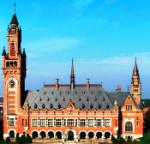 به منظور توسعه و ترویج حقوق بین الملل در ميان جامعه ايراني اخيرا با همت تعدادي از اساتيد و صاحبنظران مسايل حقوق بين الملل، موسسه حقوق بين الملل پارس تهران به شماره 30733/ث32/86 مورخ 28/12/1386 به ثبت رسيد. هدف اصلی موسسه مطالعه و پژوهش در زمینه موضوعات حقوقي بین المللي، حمايت از چاپ و انتشار تاليفات مرتبط با حقوق بين الملل و برگزاری سخنرانی ها و نشستهاي علمي مي باشد. در اين راستا از كليه اساتيد، محققان و دانشجویان علاقه مند به همكاري دعوت مي گردد، درخواستهاي خود را به انضمام برگه ای مشتمل بر پيشينه تحصیلی و تحقیقاتی خود به پست الكترونيك موسسه ارسال نمایند.